


 Educast Nepal
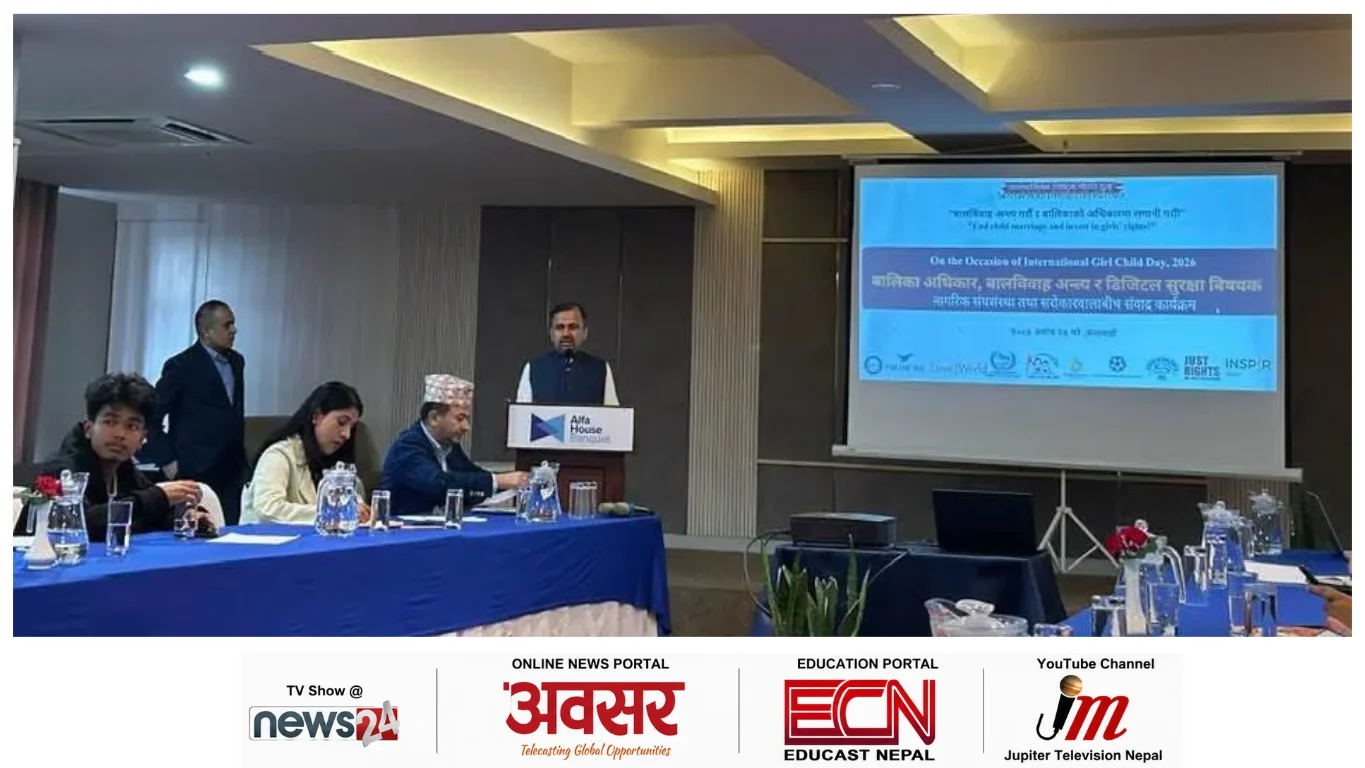
EDUCAST, Stakeholders have stressed the need to end child marriage and increase investment in the rights of girls, calling for effective implementation of existing laws and the support of all sections of society.

Speaking at an interaction program jointly organized Jcycn, CZOP, N-CFLG Forum, SPCSN, Voice of Children, Just Rights for Children, National Coalition for Girls’ Rights Nepal, One Love One World, For The One Nepal, and Inspire Nepal. It was held in collaboration with Caritas Germany, Plan International, Save the Children, CARE Nepal and UNICEF on Friday, they said the issue still does not get the attention it deserves.
The program on girls’ rights, ending child marriage and digital safety was held to mark the International Day of the Girl Child 2026. More than 60 people took part. Program was welcomed by Kabita Shah, Child Right Activist.
Presenting a paper on the situation of girls, child marriage and digital safety, Tarak Dhital, a senior child rights activist, said child marriage is most common in communities facing economic hardship, with Madhesh Province recording the highest prevalence. Only about one-third of those who marry as children continue their schooling, he said, and many are at risk of ending up in child labor.
Dhital cited social norms, lack of education and employment, peer influence and weak enforcement of the law among the causes. He urged the authorities to act without waiting for a complaint to be filed and to intervene as soon as a risk is identified.
Ram Bahadur Chand, information officer of the National Child Rights Council, said the government has been investing in girls’ rights. The federal and provincial governments have introduced separate procedures and programs for the empowerment of girls, he said. He added that all three tiers of government are working with civil society organizations to end child marriage.
Rewa Regmi of the National Human Rights Commission said the commission has conducted a national inquiry on child marriage in all seven provinces.
Chairing the program, Tilottam Paudel, president of Children as Zones of Peace National Campaign (CZOP) and Jagriti Child and Youth Concern Nepal (Jcycn), said child marriage, child labor and child trafficking can rise further during disasters and other crises. He said the safety of girls and adolescent girls needs far more attention at such times and stressed that stakeholders must be more accountable for protecting them.
Paudel said child marriages continue to take place but are rarely registered as cases. “The cases show up in the data, but we do not see them being registered with the police,” he said. “They exist only in statistics.”
He shared the experience of the Girls’ Learning and Resource Center established in Devchuli, Nawalpur by the demands of girl for safe learning sport, saying it has already started to deliver results. He said similar centers should be set up in every district and local level. Investing in girls, he added, is the way to end all kinds of harmful practices and request everyone to visit once to share learning.
Paudel also highlighted the close link between girls’ rights and social protection, emphasizing the effective implementation of existing laws alongside stronger counselling and awareness programs. He stressed the importance of girls’ empowerment in enabling girls to recognize, respond to, and seek support against different forms of abuse and violence. He also shared good practices and experiences from Jcycn’s Girls’ Empowerment Program.
He further emphasized that girls become particularly vulnerable to abuse, exploitation, and human trafficking during disasters. In this regard, he highlighted the collaborative efforts of Jcycn and Peace Himalaya, with support from partners including ONGD and Caritas Germany, Muslim Hand to provide anti-human trafficking orientation to girls and adolescents staying in holding and day-care centers in Rasuwa.
Writu Bhatt rai, chairperson of the National Coalition for Girls’ Rights (NCGR) and the National Action and Coordinating Group to End Violence against Children (NACG), said girls appear to face double discrimination. Their concerns are overshadowed within the wider women’s agenda, she said, and they are also sidelined as minors. She suggested setting up a special mechanism for girls, possibly within the National Women Commission or the National Human Rights Commission.
Raju Ghimire, from Voice of Children, said child marriage and online safety become even more sensitive during disasters and pandemics. He drew attention to the growing online violence against girls.
Dhital also warned that artificial intelligence and deepfake technology have added to these risks, including fake explicit images and fake social media accounts.
Irshad Ansari of Plan International and Amrita Paudel of ECPAT Luxembourg said everyone must work together to end child marriage and ensure girls’ education and also mentioned Plan International is also working on Ground for child protection and relief support.
Bishnu Thapa of Just Rights for Children, Prakash Khatiwada of Girls Not Brides Nepal, Sunil Lama of One Love One World, Rajendra Chaulagain of the Social Protection Civil Society Network (SPCSN) and Jyoti Chaudhary, among others, said local governments must be made more active and accountable in protecting girls and ending child marriage. Speakers also said the issue should be linked with child-friendly local governance. The discussion more focused on the Need to Investment on the Girls for the Betterment of Future.
Young participants said many girls are not aware of how social media and digital tools can be misused against them. They called for a common understanding of child marriage, clarity in the law, greater awareness among parents and open dialogue between parents and children.
Participants also stressed the need to implement the National Strategy to End Child Marriage, 2082.
According to the 2021 census, Nepal has 9.87 million children under 18. Of them, 4.75 million, or 48.17 percent, are girls. Article 39 of the Constitution prohibits child marriage and all forms of abuse and exploitation of children.
The International Day of the Girl Child has been observed on October 11 every year since 2012. This year’s theme is “End child marriage and invest in girls’ rights.”


Jupiter Media Pvt. Ltd.
DOI No. 1854/076-77
015581367/ +97709841712200
Opposite to UMN, Upakar Marg, Thapathali-11, Kathmandu Nepal
Chairman: Raju Acharya
Director: Sunil Acharya
Editor: Tara Nath Dhakal
Cameraman: Hari Khadka
Reporter: Shashi Ram Bon
Concept: Lokendra Bhandari









Write your comment