1,304 Views
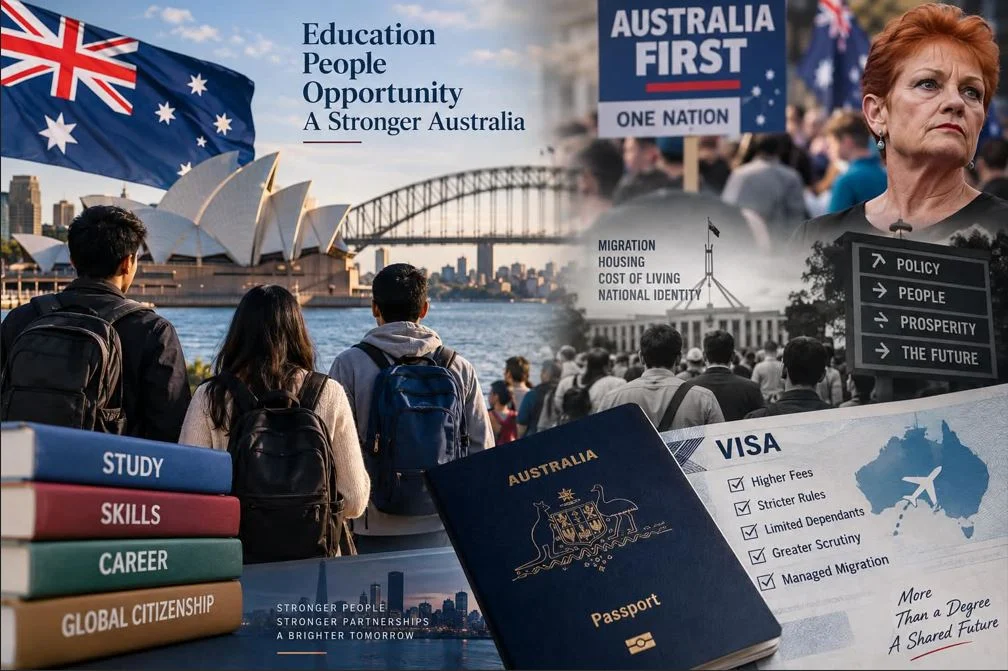
EDUCAST, Australia’s September political debate is about more than migration numbers. It concerns national identity, political power, and the future of a society built through immigration.
At the centre of the debate is Pauline Hanson and her One Nation party, whose nationalist politics have brought questions of migration and belonging back into the national conversation. The debate also reflects a wider international political phenomenon in which identity, sovereignty, and national interest have become powerful instruments of political mobilisation.
Comparisons with Donald Trump, Narendra Modi, and Xi Jinping offer a broader analytical perspective, but their political systems, ideologies, and governing contexts differ substantially. The relevant question is not whether they represent identical political models, but how contemporary nationalism uses national identity, popular sentiment, and political authority to shape public life.
Meanwhile, Prime Minister Anthony Albanese’s Labor government faces pressure over migration, population growth, housing affordability, and infrastructure capacity. These are substantial policy challenges that require more than political slogans or short-term responses.
For Nepal, this is not a distant matter.
Australia has become deeply connected to Nepal’s educational aspirations, household finances, professional ambitions, and diaspora development.
Australia’s September debate is therefore not simply Australia’s problem to solve. It is a development that Nepal must understand.
NEPAL CANNOT AFFORD POLITICAL DISTANCE
For decades, Nepal has approached Australia primarily through the lens of international education.
Students leave Nepal seeking degrees, professional opportunities, and a better future. Families make significant financial commitments. Consultancies connect students with institutions. Universities build recruitment networks. Over time, individual mobility becomes a relationship between societies.
That relationship has now grown beyond education.
The Nepali community in Australia includes healthcare professionals, researchers, skilled workers, entrepreneurs, graduates, families, and community leaders. Their lives connect Nepal and Australia through employment, investment, knowledge, culture, and civic participation.
Recent findings illustrate the scale of this relationship:
- Community growth: By June 2025, 213,580 people of Nepali origin were living in Australia—nearly five times the size of the community in 2014.
- Educational mobility: Among survey respondents, 61.16 percent had travelled to Australia for higher education.
- Economic integration: Approximately 45.27 percent reported annual incomes between AUD 65,000 and AUD 120,000, while 34.99 percent reported formal investments in Australia.
WHEN MIGRATION BECOMES POLITICAL CURRENCY
Migration has become one of the most consequential fault lines in Australia’s political debate. As housing costs rise, infrastructure faces pressure, and population growth becomes a subject of public concern, immigration is increasingly drawn into a broader argument about who benefits from Australia’s economic model—and who is expected to bear its costs.
The September 2026 polling figures offer a striking snapshot of this changing political environment.
A Newspoll conducted between September 14 and 17 placed One Nation at 30 percent, ahead of Labor at 27 percent, the Coalition at 19 percent, and the Greens at 13 percent. Labor’s primary vote was reported as its second-lowest in Newspoll history, while Albanese’s net approval rating fell to minus 27.
These figures represent more than demographic expansion. They indicate how migration has become entangled with broader public concerns about the cost of living, housing pressures, and confidence in political leadership. One Nation’s support must be understood within this wider context rather than attributed to migration policy alone.
For Nepal, the implications are immediate. When migration becomes a political instrument, its consequences reach far beyond the ballot box. They enter the lives of international students, families, workers, education providers, and diaspora communities whose futures are connected to Australia.
The question for Nepal is not which Australian political party benefits from this moment. It is whether Nepal’s institutions understand how political shifts in Canberra can reshape the opportunities and vulnerabilities of Nepali citizens.
THE AUSTRALIAN EDUCATION BRAND: TRUST UNDER PRESSURE
Australia’s international education reputation was not built by accident. It emerged from a deliberate combination of institutional quality, regulatory credibility, global engagement, and the promise of opportunity. Over time, Australia transformed itself into a major destination for international students, including thousands from Nepal. Its universities, vocational institutions, cities, and multicultural environment became part of a powerful global education brand—one that shaped the aspirations of students, families, and education advisers across the world.
The Education Services for Overseas Students (ESOS) Act 2000 established a central legal foundation for regulating the sector. Supported by the National Code and related instruments, the framework was designed to clarify provider responsibilities, protect international students, and strengthen public confidence in Australian education. This regulatory architecture helped Australia position itself not simply as a destination for foreign students, but as a trusted participant in the global education market.
That trust has significant economic value. In the 2024–25 financial year, Australia’s education-related exports were valued at A$53.6 billion, according to the Australian Government’s Department of Education.
However, the foundations of this success are now facing greater regulatory and political pressure. Since 2023, Australia has progressively tightened its international student visa system to manage net overseas migration (NOM), strengthen sector integrity, respond to housing and infrastructure concerns, and restrict “visa hopping.” The reforms have introduced stricter Genuine Student requirements, higher English-language and financial-capacity thresholds, work-hour restrictions, limitations on onshore visa switching, and stronger scrutiny of education providers.
The financial cost of entry has also increased. The Student visa application charge rose from A$2,000 to A$2,500 on 1 July 2026, while the Temporary Graduate visa charge increased from A$4,600 to A$5,750.
At the institutional level, the government has maintained the National Planning Level (NPL) at 295,000 new overseas student commencements for 2026 and 2027, following a level of 270,000 in 2025. The NPL, combined with provider allocations and visa-processing priorities, has connected institutional performance more closely to migration management. According to the Department of Education, the 2026 NPL is 8 percent below the immediate post-COVID peak, while student commencements were tracking below the corresponding period in 2025.
When regulatory uncertainty becomes excessive, its consequences may extend beyond student recruitment. It can affect institutional planning, international perceptions, family decisions, and Australia’s relationships with the communities that sustain its education ecosystem.
Australia’s education brand was built over decades. Its future credibility will depend on whether the country can balance migration management with educational quality, regulatory fairness, and the trust of international students.
THE DIASPORA QUESTION: FROM VISIBILITY TO INFLUENCE
Nepal has a growing presence in Australia.
Its citizens work across healthcare, education, business, research, technology, and other sectors. They participate in Australian society while maintaining personal, professional, and cultural connections with Nepal.
These relationships create opportunities for knowledge transfer, investment, professional collaboration, and diplomatic engagement.
But diaspora diplomacy cannot be reduced to celebrating community size or remittance contributions.
It requires a more developed understanding of how citizens abroad contribute to both their host societies and their country of origin.
Nepal needs stronger institutional engagement with its diaspora. This means better policy communication, more structured relationships with professional communities, and a deeper understanding of the concerns affecting Nepali citizens abroad.
The diaspora should not be approached simply as a source of remittances or a symbolic extension of national identity.
It is a community of stakeholders with its own rights, aspirations, responsibilities, and institutional relationships.
Nepal’s global presence must evolve from demographic visibility into strategic capability.
ECAN AND THE END OF TRANSACTIONAL COUNSELLING
Australia’s changing policy environment presents a critical moment for Nepal’s international education sector.
It also raises a question that the Education Consultancy Association of Nepal (ECAN) must confront directly:
What does professional success mean when a student’s future is at stake?
For too long, international education has often been discussed through the language of applications, enrolments, visa approvals, and commercial performance.
These measures have their place.
But they do not tell the entire story.
A student’s decision to study abroad involves academic suitability, financial planning, institutional quality, visa conditions, employment expectations, and long-term personal consequences.
The responsibility of a consultancy cannot end with the submission of an application—or even the approval of a visa.
Professional counselling must help students make informed decisions.
That requires accurate information, transparency, competence, and ethical responsibility.
ECAN has an important role in developing this professional culture. Its institutional responsibilities extend beyond the representation of commercial interests to professional development, policy dialogue, ethical standards, student protection, and sector accountability.
The transition from transactional counselling to professional advising will not happen through slogans.
It requires standards that can be understood, training that can be measured, and institutional practices that can be examined.
It also requires consultancies to recognise that commercial sustainability and student welfare should not be treated as competing objectives.
A sector that loses public trust eventually damages its own foundations.
ECAN can help strengthen those foundations by promoting evidence-based counselling, regulatory awareness, professional training, and meaningful engagement with education providers and policymakers.
The future of Nepal’s international education sector will depend on whether it can build trust that extends beyond the visa decision.
A STRATEGIC CALL TO ACTION
Australia’s September debate should be treated as a policy signal—not a momentary political spectacle.
Nepal’s response requires coordinated action across government, professional institutions, diaspora communities, and families.
1. GOVERNMENT OF NEPAL: BUILD INSTITUTIONAL CAPACITY
Nepal needs to treat diaspora affairs and education diplomacy as strategic policy priorities.
Education diplomacy must move beyond ceremonial engagement.
It should include sustained relationships with universities, regulators, professional institutions, and diaspora organisations.
A country that sends thousands of citizens abroad must develop the capacity to understand the systems in which they live.
2. THE NEPALI DIASPORA: ORGANISE BEFORE CRISIS
Nepali communities in Australia need stronger institutional relationships and greater policy awareness.
Constructive engagement with political representatives, educational institutions, and relevant public bodies should be sustained rather than activated only during moments of crisis.
Legal literacy, civic participation, and professional organisation can help communities navigate changing policy environments.
3. NEPALI FAMILIES: MAKE INFORMED DECISIONS
International education is a significant financial and personal investment.
Families should seek clear information about course suitability, institutional quality, financial commitments, visa requirements, employment realities, and long-term risks.
They should evaluate opportunities through reliable evidence rather than commercial promises or social pressure.
The cost of an uninformed decision can extend far beyond tuition fees.
THE QUESTION NEPAL CANNOT POSTPONE
Australia’s September debate is ultimately about the direction of Australian society. But it also reveals something about Nepal.
Nepal cannot determine Australia’s political choices. It cannot control the direction of Australian migration policy or the arguments advanced by Australian political parties.
What Nepal can do is build institutional capacity.
It can strengthen education diplomacy, improve the quality of professional counselling, engage its diaspora more systematically, communicate policy changes more effectively, and prepare its citizens for the realities of an increasingly complex international environment.
The future of Nepal’s relationship with Australia will not be shaped by governments alone. It will also be shaped by students, families, educational institutions, professional associations, and the Nepali diaspora.
Seshraj Bhattarai is an education professional, a commentator on international education and migration policy, and an MPhil/PhD scholar in Political Science at Tribhuvan University, Nepal.


 Educast Nepal
















Write your comment